Homeostasis · First look
Your life. By design.
The future you want, connected to what you do today.
Homeostasis is a whole-life operating system. It brings your goals, time, money, knowledge and daily routines into one connected plan — so you spend less time working out what comes next, and more time doing it.
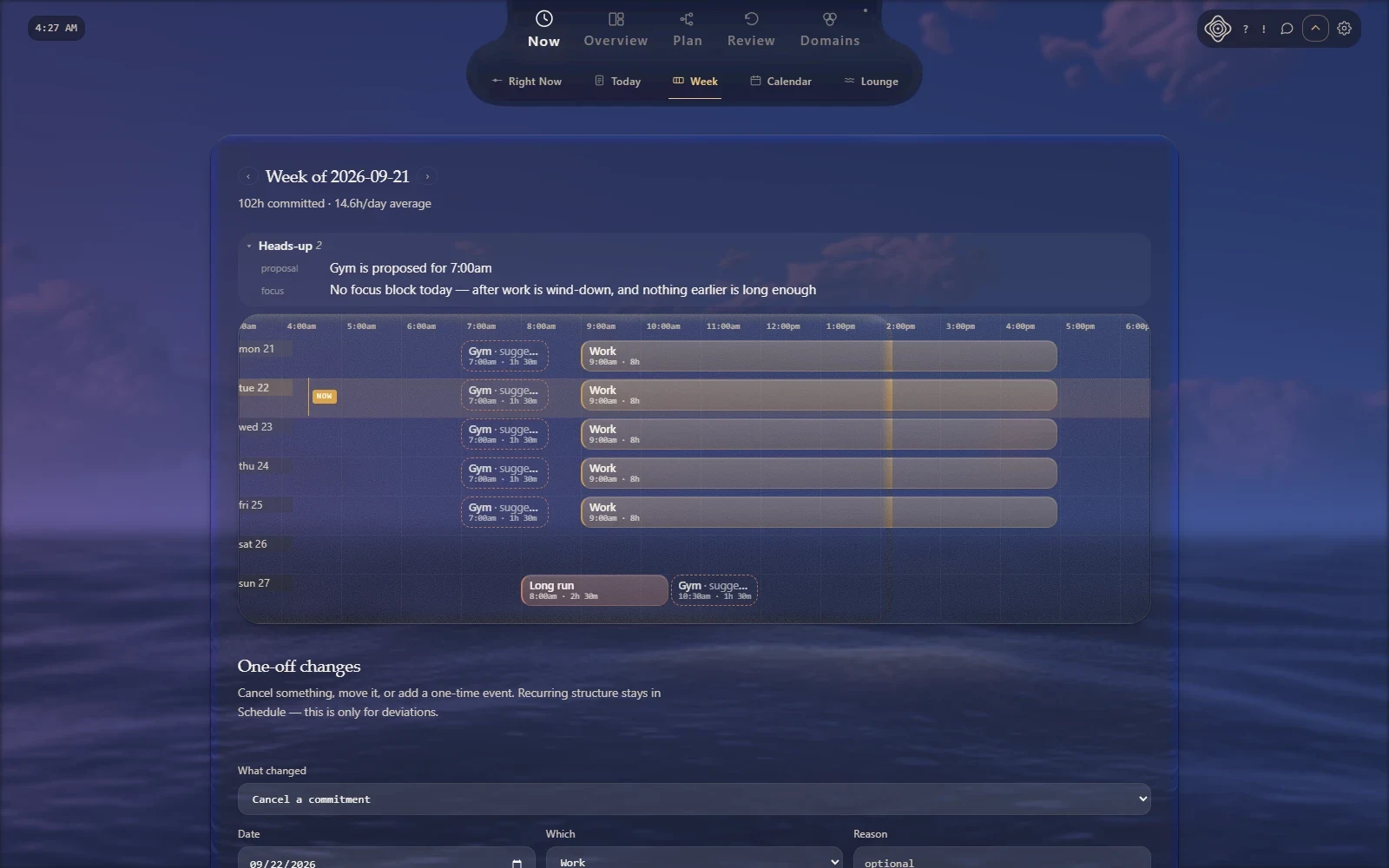
Everything you plan. Finally connected.
A calendar holds your appointments. A habit tracker records your consistency. A task manager keeps your work in order. A spreadsheet knows your money.
And you are the only thing connecting them.
You remember why a task matters. You work out how an expense moves a future purchase. You decide what has to happen first — and you rebuild the plan every time something changes.
Homeostasis gives those connections a structure. Goals connect to requirements. Requirements connect to actions. Actions connect to the time, information and money they need. That line — from the life you want to the next thing you do — is what the whole system is built around.
I went looking for a tool that worked this way, and couldn't find one. So I'm building it.
Goal decomposition
Give your ambitions a structure.
A large goal gets more useful the moment you can see what it's made of.
Break any goal into subgoals, projects, prerequisites and single actions — and keep breaking it down until the next step is obvious. Every step keeps its line back to the goal it serves. Trace an action upward to see why it matters. Follow an ambition downward to see what it will take.
The structure gives information a home, too. Research lives with the goal it informs. A cost lives with the purchase it moves. An unanswered question becomes a visible gap in the plan.
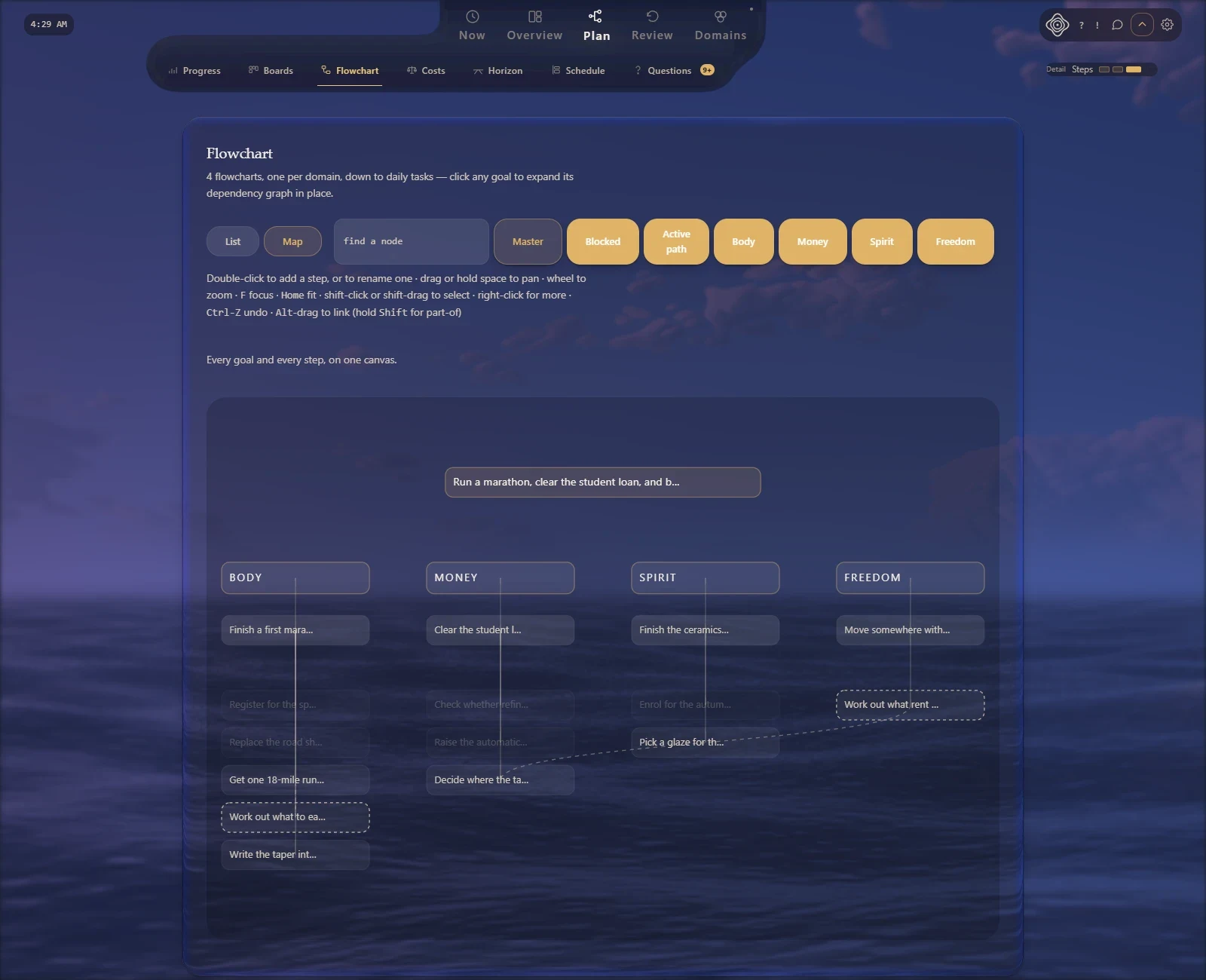
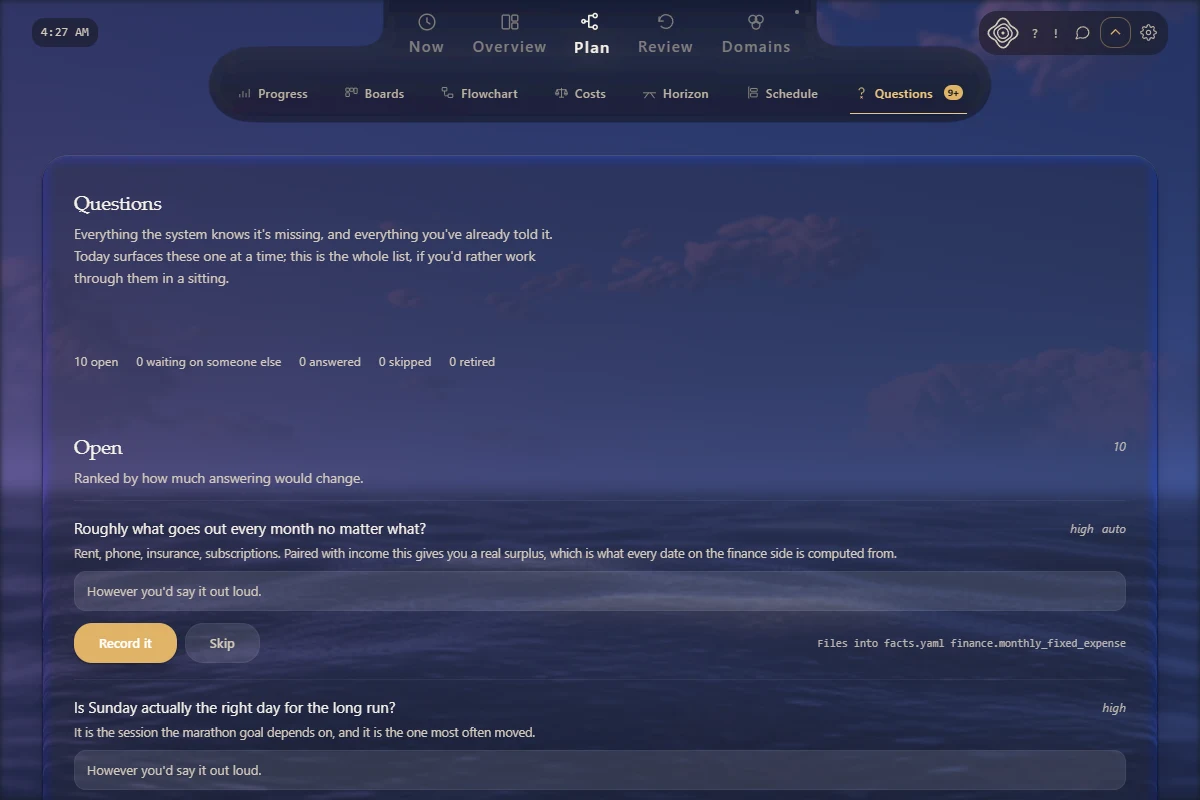
And because the plan knows what it's made of, it knows what it's missing. Homeostasis asks — one question at a time, ranked by how much the answer would change.
Perfect information propagation
Change it once. See it everywhere it matters.
One fact. One home. Reflected everywhere it applies.
- Forecasts
- Purchase dates
- Costs
- Today
Update a figure in your finances, and every calculation that depends on it follows. Finish a prerequisite, and the work it was holding back becomes available. Record progress in one view, and every other view already knows.
The flowchart, the forecasts, the calendar and the day ahead all draw from a single model of your life. Nothing to copy across, nothing to reconcile, nothing to remember to update. The arithmetic takes care of itself. The judgment stays yours.
Every scale
From the whole picture to right now.
Move between the scale you plan at and the scale you act at — long-term direction, goals, projects, horizons, calendars, weeks and days. Follow a goal inward to its next step. Step back out to see how the steps fit together.
At the closest level, Right Now puts your schedule, routines and actionable work into a single ordered list. A time block opens the thing it stands for: the workout, the meal, the routine. The details arrive at the moment you need them.
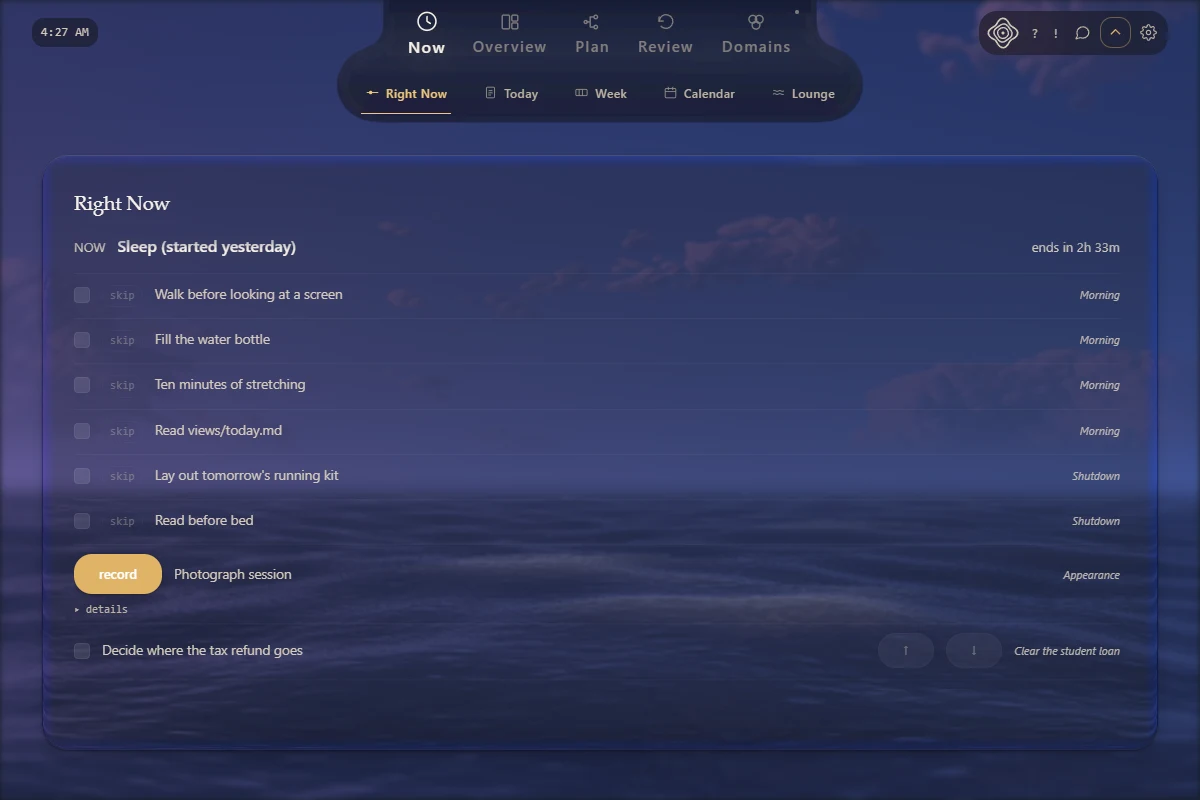
Think broadly when you're planning. Focus narrowly when it's time to start.
A whole life
Built for a whole life.
Work and training share your hours. Meals and projects share your budget. The freedom you want later depends on decisions made in ordinary weeks.
- Finances
- Training
- Meals & groceries
- Habits
- Reading
- Projects
- Routines
- Schedule
So Homeostasis doesn't stop at one part of your life. Finances, fitness, meals and groceries, habits, reading, personal projects and routines live in the same system. Dependencies show what has to come first. Gates show what's waiting — on money, on information, on a decision, or on someone else.
Declare your recurring structure once, then record only the exceptions. The plan carries itself forward without being rebuilt by hand every week.
Comprehensive underneath. Simple on the surface.
Outcomes
See where your effort is taking you.
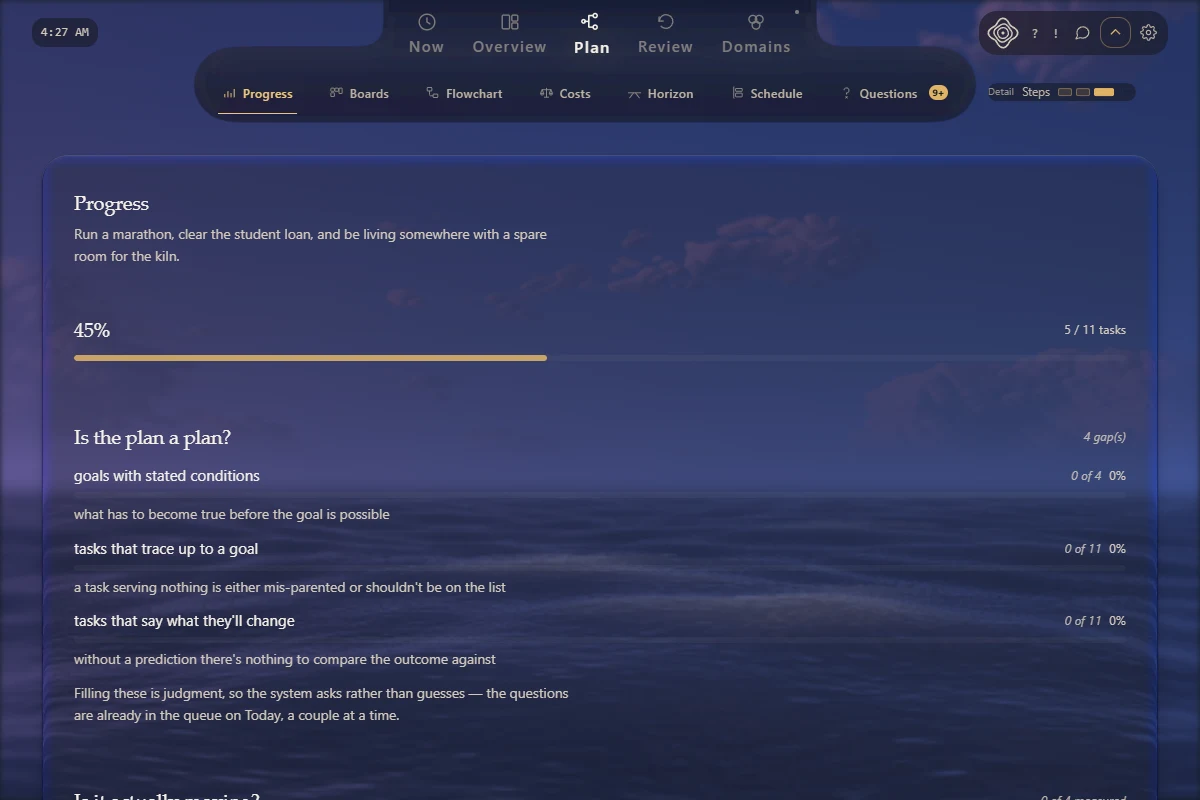
Finishing tasks and reaching goals are different things. Homeostasis connects each action to the outcome it's meant to produce, so you can compare the work you did with the change it actually made.
Forecasts make the expected path visible. Reviews show where results have drifted from the plan. And when an assumption needs another look, you get something specific to examine — not a vague sense that it isn't working.
Your plan
You remain the author.
Homeostasis starts from your definition of a life worth living. You choose the goals, set the priorities, and decide which trade-offs are worth it.
Nobody is telling you what to do.You're programming your future life.
You give your intentions enough structure that you can act on them — without making the same decisions over and over. Less time thinking about what to do. More time doing it.
Optional AI can help organise information and propose steps for you to review. The core system runs without it.
You're not following someone else's plan for your life. You're following the decisions you made — and you're free to change them.
Where it stands
An ambitious system. Already taking shape.
~90%
of the personal system's tracked scope is built
Goal decomposition, connected planning, scheduling, financial calculations, forecasting and outcome review are in place.
What remains is the work that makes it dependable for more than one person: verification, everyday polish, onboarding, and the foundations of a public service. Feature-complete is one milestone. Ready for you is the next.
The screens on this page are from the current development build — a first look at that work.
A future you choose. A day you can follow.
Follow Homeostasis for development updates, new previews, and word the moment it opens up.
The Valentine Dispatch
Follow the whole project.
New writing, training notes, and first word when the book and the programs open. One list, sent when there is something worth sending.
Created by
Andrew Valentine
Andrew Valentine trains, coaches, and writes about the mechanics underneath the body — author of The Grammar of Grappling, and once a Grandmaster-level StarCraft II player.
More from Andrew
The Grammar of Grappling
The Mechanical Principles Behind Every Technique
Ongoing · limited roster · training, nutrition and life
One-to-one coaching
Direct coaching for people who want to be told what to do and why. Training, nutrition, scheduling, and the rest of the life around them — how you spend a day, how you carry yourself, how you approach people — built as one system rather than separate plans that quietly contradict each other.
One-to-one · single sessions or ongoing
Dating & game coaching
Coaching on the part of life most advice gets backwards: attraction, approaching, conversation, and what actually governs how men and women respond to each other. How you present yourself, how you carry an interaction, and how you handle what happens next.
Single session · any subject
Advice
A straight answer to whatever you are stuck on — training, nutrition, dating, a decision, a business, a system that is not working. Bring the question and the context; get my answer and the reasoning behind it.
Digital · spreadsheet + guide
Strength programming
A calculated progression you can actually run: undulating loading, explicit progression rules, and automatic weight calculation, so every session already knows what it is asking of you.
Writing · 2026-09-26
A short guide to running a useful experiment
Field Guide Nº 3. One change, a fair comparison, and something you can learn from it — including the sessions that disappoint you.
Writing · 2026-09-25
A flowchart for Jeff Rockwell's Sit-Up Escape System
One page mapping the whole system — the core path, the escapes that branch off it, and where each one hands off to another. A review aid for people who already own the instructional.